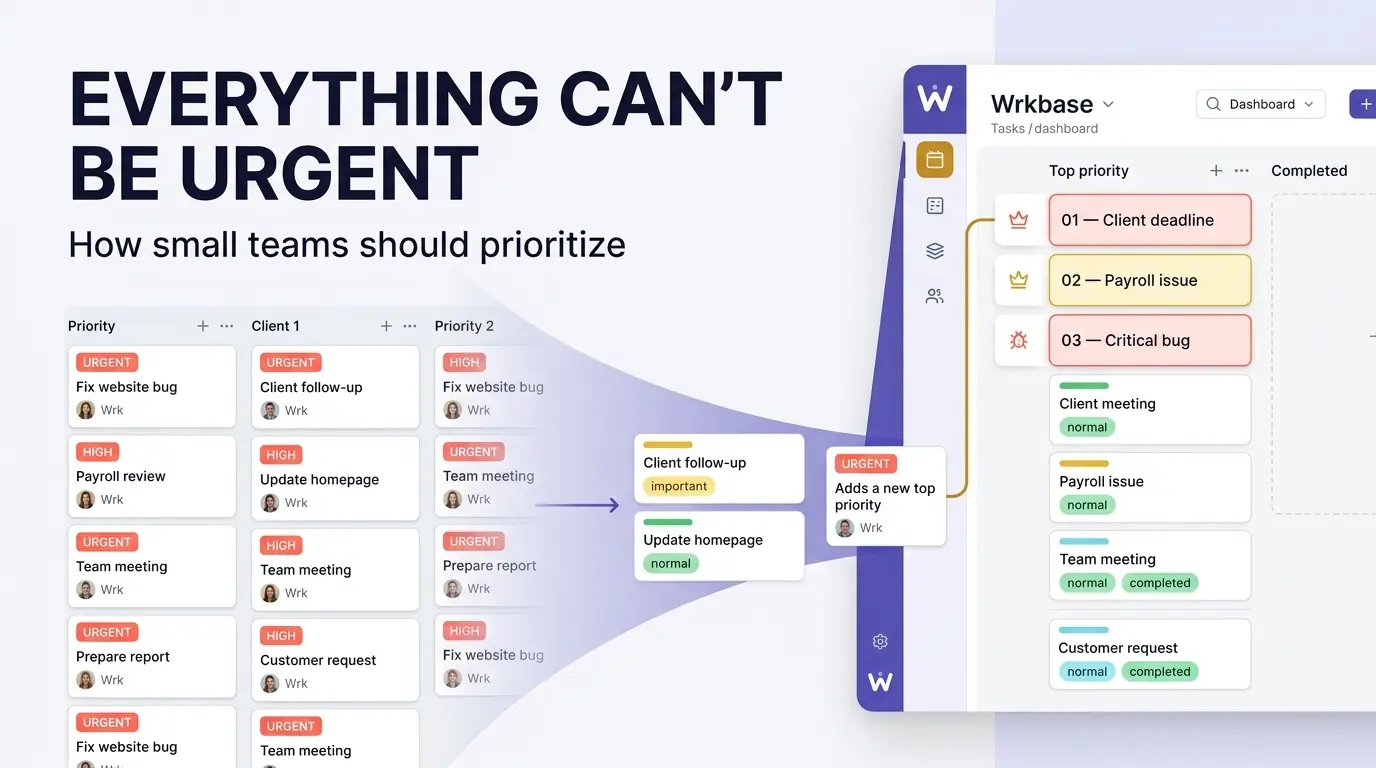
Ask a small team what's a priority and often "everything," which means priority has stopped functioning as a signal at all. On a small team without a dedicated project manager, this usually isn't a tooling problem, it's a habit problem: nobody ever removed anything from the top tier, so the top tier grew to include most of the board.
The 4-step fix for priority inflation
Separate urgent from important, on purpose
Urgent means it has a deadline pressing on it right now. Important means it moves the business forward, regardless of when it's due, the same distinction Eisenhower made famous long before task boards existed. A lot of what feels urgent (a Slack message asking for status, a minor bug someone noticed) is neither, and a lot of what's important (fixing the process that keeps generating urgent fires) never feels urgent enough to get scheduled. Sorting on both axes, not just "how loud is the ask," is the actual fix for priority inflation.
Cap how much can be top priority at once
A hard, explicit limit, for example no more than three items marked highest priority per person at a time, forces a real choice instead of letting the label creep upward by default. Adding a new top-priority item should mean actively deciding something else drops down, not just tacking one more onto an already-long list.
Review the list on a cadence, not just when it feels urgent
Priorities set once at the start of a sprint or week quietly go stale as new information arrives. A short, recurring review, even five minutes at the start of the week, is what keeps priority meaning something, rather than reflecting whatever was true three weeks ago when it was first set.
Let the tool carry the signal, not a separate conversation
Priority only works as a team-wide signal if everyone can see it without asking. A shared board where priority and labels are visible on the card itself means a new hire or a teammate picking up slack can tell what matters most without a side conversation, which is the entire point of setting it in the first place.
Two failure modes that quietly undo all of the above
The first is priority by whoever complains loudest, a task jumps the queue because someone pinged about it directly, not because it's more important than what was already top of the list. It trains the team to escalate instead of trusting the board, and the loudest request wins regardless of real impact. The fix is procedural, not technical: a request that skips the board doesn't get worked, full stop, even from a manager.
The second is priority that never gets removed, only added. A task marked urgent in week one is still marked urgent in week six because nobody revisited it, so the label stops carrying information at all. This is what the cadence review in the previous section exists to catch, an item that's sat at top priority for three review cycles without moving is either not top priority, or it's blocked on something that needs to be the real priority instead.
Should urgent-but-unimportant work ever just get dropped, not just deprioritized?
Sometimes, yes, and it's worth saying explicitly rather than letting it rot at the bottom of the board forever. A task that's sat below the top few priorities for months without ever becoming urgent enough to do usually isn't a real priority at all, it's dead weight the board is still carrying. The cadence review from earlier should include actively closing or deleting those, not just re-ranking them lower again every time.
Do small teams need a formal framework like RICE or MoSCoW?
Usually not, and adding one is often the over-engineering trap for a team this size. Those frameworks earn their keep once scoring dozens of competing initiatives against each other is the actual job. A small team's real problem is almost always simpler: too many things marked top priority at once, with no cap and no review cadence. Fix that first, a scoring framework layered on top of an already-disciplined board is a later problem, not this one.
Free for up to 5 people
What is Wrkbase?
Employee management software for small teams: tasks, time tracking, attendance, leave, payroll and HR in one place.
Start freeFree PTO accrual calculator
See the paid time off someone earns each pay period and their balance today. No sign-up.
Summarize this post with AI

Written by Sakib Islam, founder of Wrkbase
Notes on how the product is actually built.
Next up
Task management vs. project management vs. work management