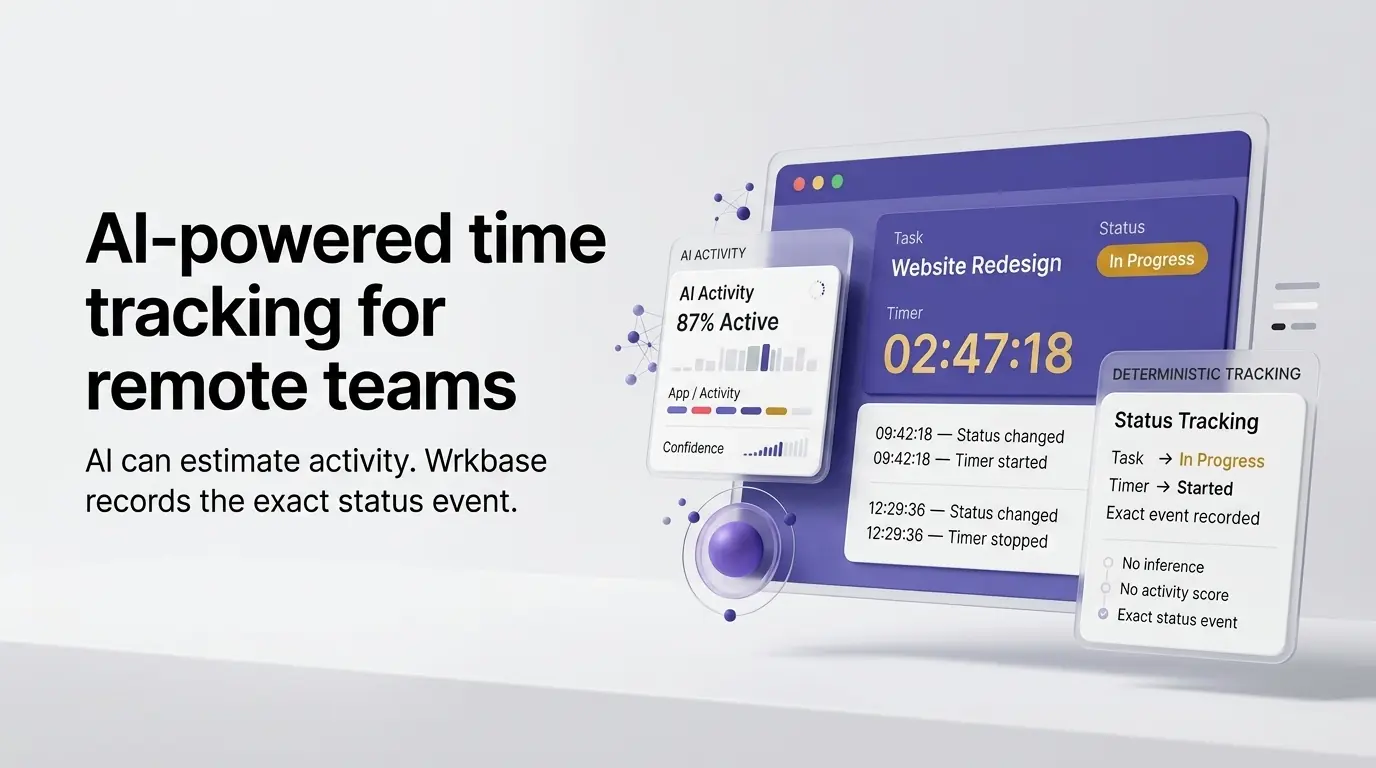
"AI-powered time tracking" is a real, distinct product category now. Tools like Hubstaff, Jibble, and Kytes market dedicated AI features for it. Usually that means guessing whether someone is actively working from activity signals, or auto-categorizing time into project buckets after the fact. Wrkbase is automatic time tracking for remote teams too, but not that kind, worth being precise about which one is being described before assuming they mean the same thing.
What "AI-powered" usually means here
In most tools in this category, AI is doing one of two jobs. The first is inferring whether time was actively worked from mouse/keyboard activity and app usage (an activity-percentage or idle-detection model). The second is automatically classifying logged time into the right project or client after it's recorded, instead of a person tagging it by hand. Both are useful, and both are probabilistic: the system is making a best guess. That means false positives (flagged as idle during real focused work with no clicking, like reading or a call) and false negatives (activity counted as work when it wasn't). Both are a real, accepted trade-off of the approach.
Wrkbase's version: deterministic, not inferred
Wrkbase's time tracking is automatic in a different sense: the timer is a direct byproduct of a task's status changing to In Progress, and stops the moment it changes again, for any reason. There's no model guessing at whether the time was "real" work from activity signals, because nothing is being inferred. The timestamp is generated by the same status change a person was already making on the board. That means no false-idle flags during a long call or a reading-heavy stretch with no clicking. It also means it can't auto-detect idle time the way an activity-based AI model can: a real trade-off, not a hidden gap.
Where Wrkbase's AI shows up instead
Wrkbase does have a real AI feature, the agent, it's just not attached to time tracking's core mechanism. The agent can be asked to reassign tasks, draft a plan across the workspace, or flag something in payroll, and executes only after a human confirms the specific plan. Time tracking itself stays deliberately simple and rule-based: predictable, explainable, and auditable in a way a probabilistic activity model isn't. Every logged minute traces back to an exact status change, not a confidence score.
Which approach fits your team
If the requirement is activity-level proof, idle detection, or automatic project classification from behavior, an AI-activity tool like Hubstaff or Jibble is built for that. It does it better than a rule-based system ever will. If the requirement is simpler, accurate hours that trace back to real, explainable status changes with nothing inferred or guessed, Wrkbase is built for that instead, free for teams up to 5, no card required.
Does 'not AI-powered' mean less accurate?
Not necessarily, it's accurate at a different thing. An AI activity model estimates whether work was happening during logged time, a real and sometimes-needed capability. A status-driven timer doesn't estimate anything. It records an exact event a person already caused by moving a task, so there's no guess involved. But it also can't tell you whether someone was focused during that window, only that the task was marked in progress.
Questions this post answers
Does 'not AI-powered' mean less accurate?
Not necessarily, it's accurate at a different thing. An AI activity model estimates whether work was happening during logged time, a real and sometimes-needed capability. A status-driven timer doesn't estimate anything, it records an exact event a person already caused by moving a task, so there's no guess involved, but it also can't tell you whether someone was focused during that window, only that the task was marked in progress.
Employee management software for small teams: tasks, time tracking, attendance, leave, payroll and HR in one place.
Start freeSee the paid time off someone earns each pay period and their balance today. No sign-up.
Open the calculator