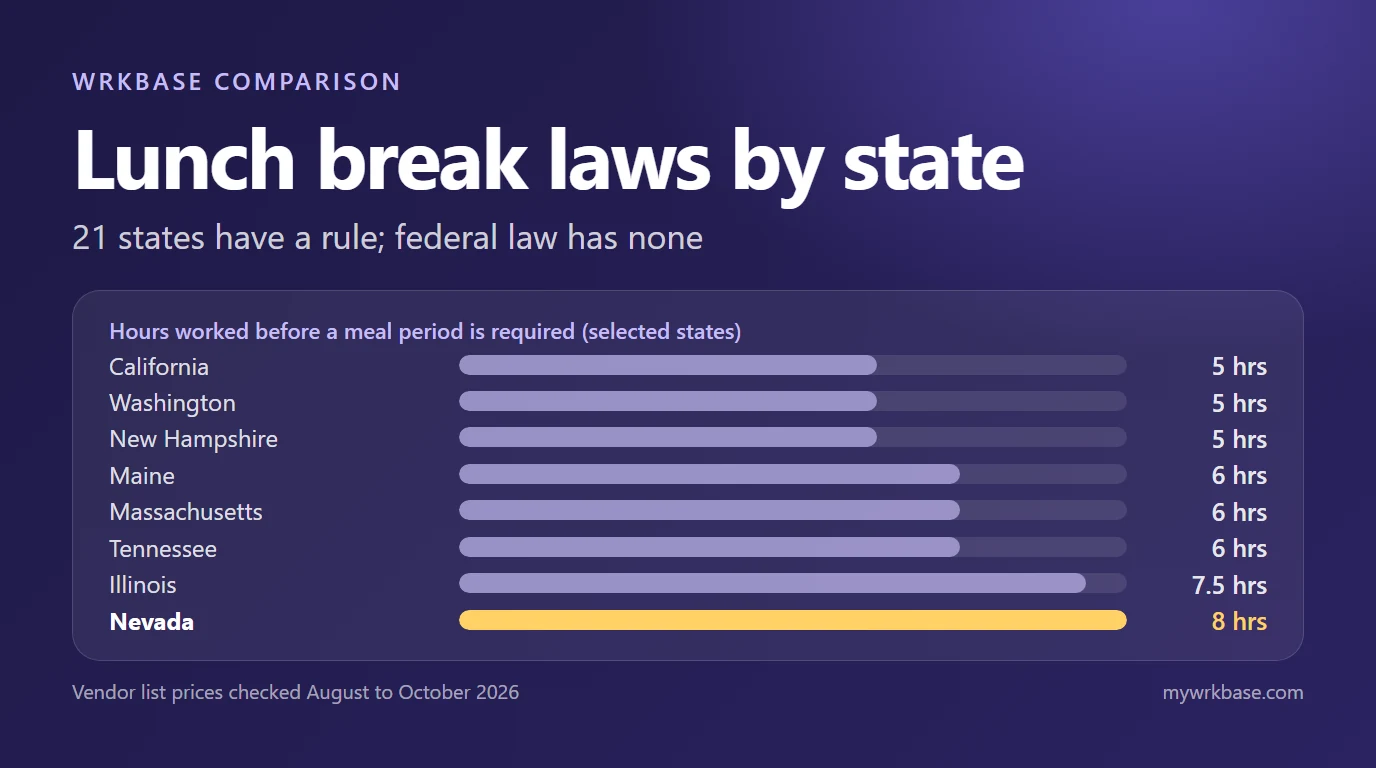
Short answer on lunch break laws by state: federal law does not require employers to give a lunch break, but 21 states do, along with Guam and Puerto Rico, usually for shifts of about 5 to 8 hours. The rules differ on when the break is due, how long it is, and whether it is paid. The table below comes from the US Department of Labor and was last updated on 1 January 2023, so treat it as a starting point and confirm with your state labor office before you rely on it.
What federal law says
The Department of Labor's breaks page states that federal law does not require lunch or coffee breaks. When an employer does offer short breaks, usually 5 to 20 minutes, they count as hours worked and toward overtime. A meal period of typically at least 30 minutes is not work time and is not paid, as long as the employee is fully relieved of duty. The page cites 29 CFR 785.18 and 785.19 and shows no date; we read it on 31 October 2026.
The state meal period rules
This summarises the Department of Labor's state meal period table, last updated on 1 January 2023, which we read on 31 October 2026. It lists only jurisdictions with a requirement. Where the table is silent on pay, so is this one. Exemptions are common, so each row is a summary, not the full rule.
| State | When it applies | Meal period | Notes |
|---|---|---|---|
| California | Over 5 hours | 30 minutes | A second meal period over 10 hours; some industries and union-covered workers exempt |
| Colorado | Over 5 consecutive hours | 30 minutes | Four industries, with many exemptions; an on-duty meal counts as time worked when work prevents relief |
| Connecticut | 7.5 or more consecutive hours | 30 minutes, between hours 2 and 6 | Exempt if the employer gives 30 or more minutes of paid rest or meal time per 7.5 hours |
| Delaware | 7.5 or more consecutive hours | 30 minutes, between hours 2 and 6 | Exemptions for certain professionals and written agreements |
| Illinois | 7.5 or more continuous hours | At least 20 minutes, starting by hour 5 | Hotel room attendants in large counties get 30 minutes after 7 hours |
| Kentucky | Between hours 3 and 5 | Ordinarily 30 minutes | Unpaid; coffee and snack breaks do not count |
| Maine | 6 consecutive hours | 30 minutes | Not for workplaces with fewer than 3 employees on duty who get frequent paid breaks |
| Maryland | 4 to 6 hours; over 6; 8 or more | 15 minutes; 30 minutes; plus 15 per extra 4 hours | Retail only, for establishments with 50 or more retail employees |
| Massachusetts | Each 6 hours in a day | 30 minutes | The worker must be free of duties and free to leave the workplace; some industries excluded |
| Minnesota | 8 or more consecutive hours | Sufficient time | Unpaid; rest periods under 20 minutes cannot be deducted |
| Nebraska | Each 8-hour shift | 30 minutes, off premises | Assembly plants, workshops and mechanical establishments |
| Nevada | 8 continuous hours | 30 minutes | Employers with 2 or more employees; union-covered workers excluded |
| New Hampshire | After 5 consecutive hours | 30 minutes | Not required if the employee can eat while working and the employer allows it |
| New York | Varies by industry and shift | Varies; for example 30 minutes at noon for shifts over 6 hours in non-factory settings | Factories have a 1-hour noon period; extra periods apply to some shifts. Check the state page |
| North Dakota | Each shift over 5 hours | 30 minutes, if desired | Applies with 2 or more employees on duty; fully relieved employees need not be paid |
| Oregon | 6 to 8 hour work period | 30 minutes with full relief from duty | Alternatives are a paid 20 minutes or a paid on-duty eating period; union-covered workers excluded |
| Rhode Island | 6-hour shift; 8-hour shift | 20 minutes; 30 minutes | Excludes licensed health care facilities and employers with fewer than 3 people per shift |
| Tennessee | 6 or more consecutive hours | 30 minutes, not in or before the first hour | Unpaid; tipped food and beverage workers can waive in writing |
| Vermont | Throughout work periods | Reasonable opportunities to eat | No fixed length |
| Washington | Over 5 consecutive hours | 30 minutes, 2 to 5 hours into the shift | Counts as work time if the employee must stay on premises; an extra 30 minutes after 3 hours beyond the regular day |
| West Virginia | 6 or more hours in a day | 20 minutes | Applies to every employer |
| Guam | After 5 hours | 30 minutes | Unpaid unless work prevents relief; waivable for days of 6 hours or less |
| Puerto Rico | Over 5 consecutive hours | 1 hour, shortenable by written agreement | Time and a half if worked during the meal period; a second period over 10 hours |
Minors and other footnotes
The Department of Labor's footnotes add that 35 jurisdictions have separate meal period rules for minors, and where two rules apply the stricter one governs. Pennsylvania and Wisconsin have extra rules for seasonal farm and migrant workers. New Mexico requires no meal period, but if one is given it must be at least 30 minutes and unpaid.
What this means for timesheets and pay
If a meal period is unpaid and the employee is fully relieved of duty, it comes off the day's hours. A timesheet needs an unpaid break column for that: our free timesheet template has one, and the time card calculator takes the break off before it adds up the week. Overtime then follows your state's rule; see the overtime calculators by state.
Wrkbase's attendance records when each person signs in, takes breaks and signs off, so break time is on the record, and a timesheet fills in from it. It is a record, not legal advice: it does not apply a state's meal period law for you, so check your own state's rule above.
Questions this post answers
Does federal law require a lunch break?
No. The US Department of Labor says federal law does not require lunch or coffee breaks. Some states do, so the rule depends on where the employee works.
Is a lunch break paid?
Under federal rules a meal period of typically 30 minutes or more is not work time and is not paid, provided the employee is fully relieved of duty. Short rest breaks of about 5 to 20 minutes are paid and count toward overtime. State rules can differ, and some states require pay if the employee must stay on duty.
How many states require lunch breaks?
The Department of Labor's table lists 21 states, plus Guam and Puerto Rico, with meal period requirements, as last updated on 1 January 2023. States not listed have none in that table, though laws change, so confirm with your state labor office.
Employee management software for small teams: tasks, time tracking, attendance, leave, payroll and HR in one place.
Start freeSee the paid time off someone earns each pay period and their balance today. No sign-up.
Open the calculator